Categories
Artificial Intelligence Networking

The Next Evolution in SONiC Intelligence

At PalC Networks, our work with SONiC has always been about more than automation.
Automation is efficient but itโ€™s still reactive.

What we wanted was awareness: A network that could interpret, coordinate, and adapt.

That idea took form through Agentic AI: a framework where SONiCโ€™s critical functions (configuration, telemetry, topology, security) are handled by specialized, intelligent agents.

But as we scaled, one challenge became clear: Intelligence, if isolated, becomes another form of silo.

Each agent could perform brilliantly on its own, but real autonomy requires more, A shared consciousness.Thatโ€™s where the MCP (Multi-Agent Coordination Plane) comes in.
Itโ€™s the layer that turns multiple intelligent agents into a cooperative, adaptive ecosystem.

From Orchestration to Collaboration

Traditional orchestration relies on centralized control using one brain to manage the entire network.

Modern networks are organic with thousands of devices, millions of telemetry signals, and unpredictable traffic patterns.

Scaling intelligence doesnโ€™t mean building a bigger brain. It means building many smaller ones where each one is capable of learning, reasoning, and collaborating.

Thatโ€™s the foundation of MCP:

Every SONiC agent becomes an independent node that can:

  • Understand its local state
  • Exchange context with peers
  • Coordinate decisions through the MCP layer

Together, they form a federation of specialized minds which means faster, more resilient, and inherently aware of the whole.

MCP Explained: The Missing Link Between Automation and Autonomy

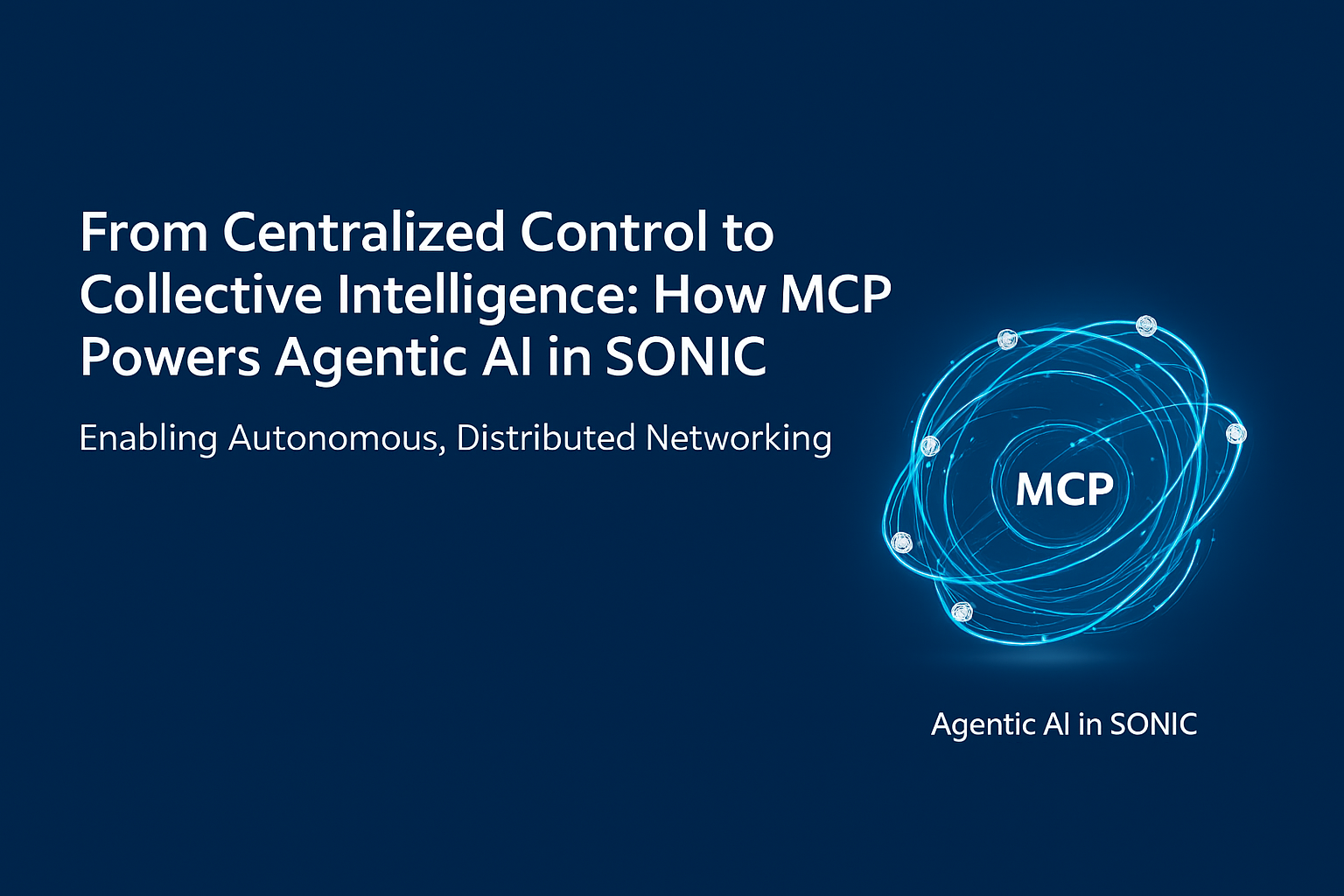
The Multi-Agent Coordination Plane is a distributed intelligence fabric that connects multiple SONiC agents into one unified reasoning system.

In our Agentic AI architecture, MCP acts like a nervous system for the network:

  • Each agent (Config, Telemetry, Topology, Security) behaves like a neuron.
  • MCP is the synaptic layer that carries signals and aligns actions.
  • Together, they create a collective intelligence becoming self-aware, self-optimizing, and contextually driven.

How MCP Works

1.Distributed Reasoning
Each agent monitors, configures, or optimizes within its domain, while MCP ensures a shared state across them.

2.Context Sharing
When telemetry flags congestion, MCP routes that insight to configuration and topology agents, prompting proactive adjustments.

3.Decision Synchronization
MCP prevents conflicting actions, ensuring coordinated, safe changes across agents.

4.Learning & Feedback
Over time, MCP identifies patterns in cause and effect, improving the networkโ€™s ability to predict and prevent disruptions.

Business Impact: Why MCP Matters for Enterprises

MCP is more of a business enabler than being an architectural improvement.
It turns reactive infrastructure into a self-optimizing system that saves time, cost, and risk.

Enterprise Challenge MCP Solution
Manual, reactive operations Predictive, AI-driven coordination before failures occur
Configuration errors Pre-validation, rollback, and cross-agent verification
Fragmented monitoring Unified loop between telemetry, config, and topology
Scaling complexity Distributed, localized decision-making for faster remediation
Compliance and audits Built-in traceability for every autonomous action

By distributing reasoning across nodes, MCP transforms the data center from an operational burden into resilient, compliant, and aware ecosystem.

Turning SONiC Agents into Collaborators

Hereโ€™s how collaboration unfolds inside PalCโ€™s Agentic AI framework:

  • Intent Interpretation: The orchestrator translates operator intent (e.g., โ€œDeploy a 4-leaf, 1-spine fabric with telemetry enabledโ€).
  • Delegation via MCP: Tasks are distributed into Configuration sets up interfaces, Topology maps links, Telemetry preps sensors.
  • State Synchronization: Agents continuously share updates, ensuring decisions remain consistent and validated.
  • Adaptive Execution: MCP learns from each event, fine-tuning coordination for future scenarios.

SONiC, through MCP, shifts from being managed to self-managing.

When Each Agent Thinks and Learns

Each agent grows smarter through experience:

  • Config Agent: Learns from historical changes to suggest safer rollouts.
  • Telemetry Agent: Detects patterns to predict congestion or performance drift.
  • Topology Agent: Recalculates paths dynamically under load or failure.
  • Security Agent: Applies policies based on live context, not static rules.

Through MCP, these agents share learning, building a network that’s intelligently aware.

Traditional Automation Agentic AI + MCP
Centralized control Distributed coordination
Static rule execution Context-aware reasoning
Manual incident handling Autonomous self-healing
Configuration scripts Intent-driven adaptability

MCP turns SONiC fabrics into cooperative, evolving systems

PalCโ€™s Vision: Engineering Distributed Autonomy

Our MCP framework fuses AI reasoning, SONiCโ€™s openness, and operational discipline into a distributed, resilient control model.

The goal is to give networks the ability to handle complexity, so humans can focus on innovation.

The outcome:

  • Networks that heal themselves.
  • Operations that think in context.
  • Infrastructure that acts with intent.

Key Takeaways

MCP (Multi-Agent Coordination Plane) enables real-time coordination among SONiC agents.
Agentic AI transforms SONiC from automated to intelligent.
PalC Networks delivers the engineering and ecosystem to make open autonomy practical.
The result: open, intelligent, business-aware data centers built for the future.

Contact us today to learn how PalC Networks can support your journey towards future-ready infrastructure.

Categories
Artificial Intelligence Networking

How PalC Networks builds trust and resilience into open networking deployments

Why โ€œOpenโ€ Needs โ€œAssuranceโ€ย 

Open networking is no longer a fringe experiment โ€” itโ€™s the foundation of modern data center infrastructure.
SONiC, the open-source network operating system born at Microsoft and nurtured by the Linux Foundation, is now powering hyperscale and enterprise data centers alike.
But in regulated industries โ€” finance, government, healthcare, and telecom โ€” openness alone isnโ€™t enough.
These environments demand traceability, compliance, and continuous assurance.

The question isnโ€™t just โ€œCan SONiC run at scale?โ€
Itโ€™s โ€œCan it meet audit, compliance, and security standards โ€” without losing its open DNA?โ€

Thatโ€™s where hardening becomes essential.

What โ€œHardened SONiCโ€ Really Means

In PalCโ€™s terminology, Hardened SONiC is not just a patched OS.
Itโ€™s a tested, validated, and continuously supported build of SONiC, engineered for production use in environments where downtime or misconfiguration is unacceptable.

A hardened SONiC image from PalC includes:

  • Extended regression and conformance testing across multi-vendor ASICs and hardware platforms.
  • Security baselines patched CVEs, role-based access controls (RBAC), secure logging, and firmware validation.
  • Operational guardrails validated upgrade/rollback workflows, version locking, and signed images.
  • Lifecycle visibility telemetry and alert hooks tied to TAC processes for proactive support.

In short: we take SONiCโ€™s open flexibility and wrap it in enterprise-grade reliability.

Why Regulated Environments Need a Hardened SONiC Approach

Regulated sectors โ€” like BFSI, government networks, and telecom carriers โ€” live under strict mandates for data integrity, availability, and traceability.
These mandates translate directly into network design expectations.

Letโ€™s break that down.

1. Compliance by Design

Every software component must be auditable โ€” from kernel to NOS to telemetry stack.
Hardened SONiC provides version-controlled builds, cryptographic signing, and artifact traceability that meet regulatory audit standards such as ISO 27001, PCI DSS, or RBI/BIS mandates in BFSI.

2. Security by Default

Unpatched CVEs are unacceptable.
PalCโ€™s hardened builds include ongoing vulnerability tracking, secure boot enablement, ACL enforcement, and integration with external authentication (LDAP, TACACS+, RADIUS).

3. Operational Stability

Regulated enterprises operate under SLA-driven performance commitments.
SONiCโ€™s modular architecture can be both an advantage and a risk โ€” if untested combinations fail in production.
PalCโ€™s validation suite ensures all supported features (L2/L3/MPLS/EVPN/VXLAN) and vendor ASICs pass regression across 500+ functional and fault scenarios.

4. Observability and Accountability

Telemetry is not optional.
Each packet path, queue behavior, and interface statistic must be traceable.
Hardened SONiC integrates gNMI-based telemetry with PalCโ€™s NetPro Suite, enabling historical replay and audit visibility across compliance cycles.

The PalC Approach: Engineering Confidence into Openness

1. Build Validation: Qualification Across Platforms

Each PalC SONiC build goes through multi-phase qualification:

  • Hardware Compatibility Validation
    Tested on Broadcom, Marvell, and Intel platforms, ensuring feature parity and driver consistency.
  • Functional Regression
    500+ test cases covering Layer 2/3 protocols, EVPN-VXLAN, QoS, ACLs, and multi-chassis link aggregation.
  • Negative Testing
    Simulating failed links, route flaps, process restarts, and misconfigurations โ€” validating SONiCโ€™s failover logic.
  • Performance Benchmarking
    Line-rate throughput and latency benchmarks using IXIA or TRex frameworks, compared against OEM baselines.

This forms our Hardened SONiC Qualification Matrix โ€” a continuous integration pipeline that ensures each release is ready for production, not just lab demos.

2. Secure Configuration Baselines

Security in SONiC begins with the image, but extends into runtime.
Our hardening templates implement:

  • Role-Based Access Control (RBAC) for administrative isolation.
  • AAA integration with corporate identity providers (LDAP, RADIUS, or SSO).
  • Config Integrity Checkpoints โ€” SHA-signed configuration backups and change validation.
  • Secure Management Channels โ€” enforced SSHv2, TLS 1.2+, SNMPv3, gNMI/gRPC over SSL.
  • Disable default accounts and unused services as part of Day 0 provisioning.

These configurations align with CIS Benchmarks and NIST 800-53 guidelines, ensuring compliance readiness from the first boot.

3. Lifecycle Assurance & Patch Management

Open-source agility is a double-edged sword โ€” patches evolve quickly.
PalCโ€™s sustain program integrates SONiC patch cycles with enterprise change windows:

  • Patch Validation Pipelines: New commits undergo automated test runs in PalCโ€™s CI/CD lab.
  • Version Locking: Enterprises can freeze on validated releases while security patches continue to be backported.
  • Rollback Automation: Instant rollback capability in case of regression, integrated with our orchestration tools.

This process ensures that openness doesnโ€™t compromise predictability.

4. Telemetry & Compliance Observability

In regulated environments, you canโ€™t just prove uptime โ€” you must prove why it was maintained.
Using NetPro Suite, hardened SONiC deployments gain:

  • Real-time gNMI telemetry streams from switches.
  • Prometheus exporters for metrics collection.
  • Grafana dashboards for visual compliance reporting.
  • Integration with SIEM tools (e.g., Splunk, Elastic, or OpenSearch) for anomaly correlation.

Auditors can replay network states, review link utilization, and validate SLA adherence from a single pane.

5. TAC-Driven Operational Model

Even the best-engineered network will face incidents.
The difference lies in response speed and insight.

PalCโ€™s Technical Assistance Center (TAC) operates in three tiers:

  • L1: Immediate triage, log analysis, and guided recovery.
  • L2: Root-cause diagnosis, topology validation, escalation management.
  • L3: Engineering-level debugging and patch integration directly with SONiC community branches.

Every support case feeds back into our Hardened SONiC Knowledge Base, ensuring learnings become new safeguards.

This is Sustainability through Feedback Loops โ€” the more we support, the smarter the platform gets.

SONiC in FinTech Core Networks

In one of Indiaโ€™s leading FinTech payment operators, PalC deployed a SONiC-based open fabric across three high-availability data centers.
The goals were clear: vendor independence, audit readiness, and zero unplanned downtime.

Challenges included:

  • Legacy OEM lock-in and opaque management.
  • Manual firmware rollbacks during audits.
  • Limited visibility across multi-vendor devices.

Our Solution:
Hardened SONiC builds validated against the clientโ€™s exact ASICs.
Automated compliance telemetry, feeding into their security audit dashboards.
Integrated TAC support with pre-agreed SLA response tiers.
NetPro Sustain for continuous monitoring and regression validation after every change window.

The result:
40 % reduction in operational costs.
100 % audit traceability across firmware and configuration changes.
Zero downtime during compliance audits.

Proof that openness can coexist with regulation โ€” if engineered right.

SONiC in FinTech Core Networks

Hereโ€™s a distilled checklist based on our field experience:

Stage Best Practice Outcome
Design Define compliance mapping (ISO 27001, PCI, NIST). Architecture aligns with regulation before deployment.
Image Prep Use signed, tested, and version-controlled SONiC images. Verified integrity, no drift between nodes.
Access Control Implement RBAC + AAA + MFA for all admins. Prevent privilege escalation.
Telemetry Enable gNMI, stream to secure collectors. Continuous visibility and auditability.
Change Management Use configuration-as-code and CI/CD validation. Safe, repeatable updates.
Support Integrate with enterprise ticketing via TAC APIs. Rapid triage and documentation.

Why PalC Networks Leads in Hardened SONiC

PalC isnโ€™t just deploying open networking โ€” weโ€™re industrializing it.

Our contribution to the SONiC ecosystem spans RFC drafts, validation tooling, and active community participation.
But what differentiates us in regulated sectors is our ability to bridge open innovation with enterprise discipline.

We combine:

  • SONiC engineering depth (protocol enhancements, FRR stack contributions).
  • End-to-end deployment experience (design โ†’ validation โ†’ TAC).
  • A proven sustain model that aligns open-source agility with compliance rigidity.

For enterprises navigating audits, risk frameworks, and strict SLAs โ€”
PalC Networks delivers the confidence to run SONiC at scale.

Summary

The future of data centers is open, but it must also be trustworthy.
Hardened SONiC offers the best of both worlds โ€” agility without risk, freedom without fragility.
When compliance meets code, and automation meets assurance,
you donโ€™t just build a network.
You build trust at line rate.

Contact us today to learn how PalC Networks can support your journey towards future-ready infrastructure.

Categories
Artificial Intelligence Networking

The Shift Toward Reasoning Networksย 

Every evolution in networking has pursued one goal which is reducing human friction.
From command-line configurations to intent-driven automation, each step simplified execution but not understanding.
As networks now span clouds, edges, and AI clusters, complexity is no longer operational it has turned to be cognitive.
Artificial Intelligence (AI) is stepping into that gap. Not just as a data analytics tool, but as a reasoning layer for networks that can learn, infer, and decide.
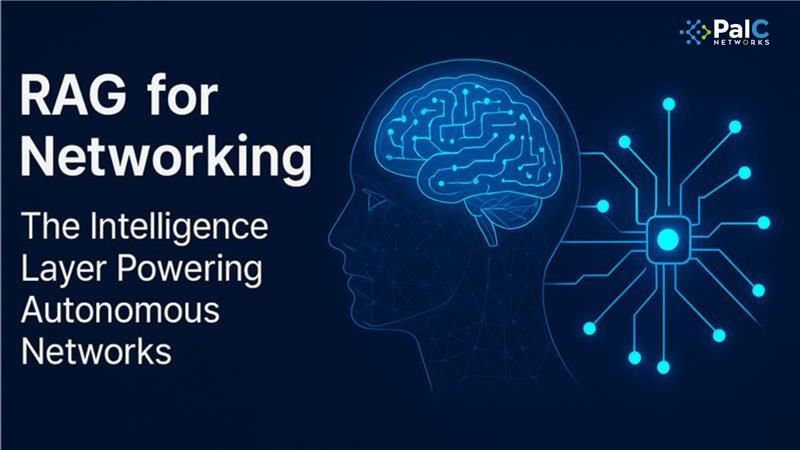
And this shift Retrieval-Augmented Generation (RAG) is a framework that allows AI to think with the networkโ€™s own knowledge.
RAG marks the point where network AI stops merely predicting and starts understanding.

The Evolution of Network Intelligence

Era Core Approach Limitation Next Step
Manual Era Human-driven configs Error-prone, inconsistent Scripted automation
Automation Era SDN, CI/CD, SONiC pipelines Reactive, limited context Contextual AI reasoning
AI Era Retrieval + Generation Needs domain understanding Self-operating cognition

The next leap isnโ€™t automation โ€” itโ€™s comprehension.
Networks that donโ€™t just execute playbooks, but understand why theyโ€™re executing them.

How RAG Fits in Networking

Networks are knowledge systems. They generate massive amounts of unstructured intelligence like telemetry, syslogs, event traps, policy states and most of which remains underutilized.

RAG converts this operational exhaust into reasoning fuel. It enables AI models to:

  • Retrieve live context: Whatโ€™s happening across fabrics, clusters, and tenants.
  • Ground reasoning: Align insights with real-time configurations.
  • Generate precision: Produce factual, explainable outcomes.

In networking terms, RAG is the bridge between observability and cognition โ€” it converts visibility into understanding.

Inside the RAG Loop

RAGโ€™s value lies not only in the workflow, but also in the reasoning feedback that emerges from it.

  1. Collect & Curate: SONiC telemetry, NetPro metrics, logs, configs.
  2. Index Knowledge: Create a searchable intelligence layer of historical and live data.
  3. Retrieve Context: Query relevant slices (โ€œWhat caused leaf-03 reboot last night?โ€).
  4. Generate Reasoning: AI synthesizes causal narratives or configuration recommendations.
  5. Learn & Adapt: Verified responses become part of the retrieverโ€™s future context.

This loop makes networks progressively smarter, not just faster.

Where RAG Redefines NetOps

  • Root Cause Reasoning: Move beyond correlation โ€” infer causation with evidence.
  • Policy Intelligence: Detect and explain compliance drifts across vendors.
  • Cognitive Assistants: Natural-language diagnostics for L1 engineers.
  • Contextual Configs: Generate validated SONiC/BGP/EVPN templates grounded in current state.
  • Adaptive Learning: Retain lessons from every RCA, ticket, or anomaly.

In effect, RAG creates a knowledge memory for the network which acts as a living library that improves operational trust and speed.

PalC Networksโ€™ Perspective: From Telemetry to Reasoning

At PalC Networks, our journey through SONiC-based fabrics, AI observability, and cloud-native orchestration has naturally converged toward RAG-driven network cognition.

Our focus areas include:

  • Integrating NetPro Suite as a real-time retrieval layer, grounding AI in verified telemetry.
  • Domain-tuned AI models that understand network semantics โ€” from L2 loops to RoCEv2 optimizations.
  • Cross-vendor contextual reasoning to unify visibility across SONiC, Cisco, Juniper, and Arista environments.

As contributors to the SONiC ecosystem and the Linux Foundation, weโ€™re advancing an open, cognitive networking paradigm โ€” where intelligence is shared, transparent, and self-improving.

Turning Data into Cognitive Advantage

Enterprises adopting RAG-based network intelligence typically realize:

  • 60% faster RCA through retrieval-grounded context.
  • Reduced operational overhead via explainable AI triage.
  • Improved onboarding as natural language replaces CLI silos.
  • Lower TCO by extending reasoning across multi-vendor networks.

Looking Ahead: From Intelligent to Autonomous Networks

The next generation of networks not only just detect or report; theyโ€™ll reason, decide, and adapt.
AI agents will retrieve evidence, simulate outcomes, and execute remediations with policy assurance.

RAG is the cognitive fabric that enables the turning static data into continuous intelligence.
Itโ€™s how networks evolve from visibility to comprehension, and from automation to autonomy.

In Closing

Retrieval-Augmented Generation marks a turning point in networking ย where AI becomes both a memory and a mind.

At PalC Networks, we believe the future of network operations lies in intelligence built on understanding & networks that can explain themselves as well as they perform.

Contact us today to learn how PalC Networks can support your journey towards future-ready infrastructure.