Categories
Artificial Intelligence

The Next Evolution in SONiC Intelligence

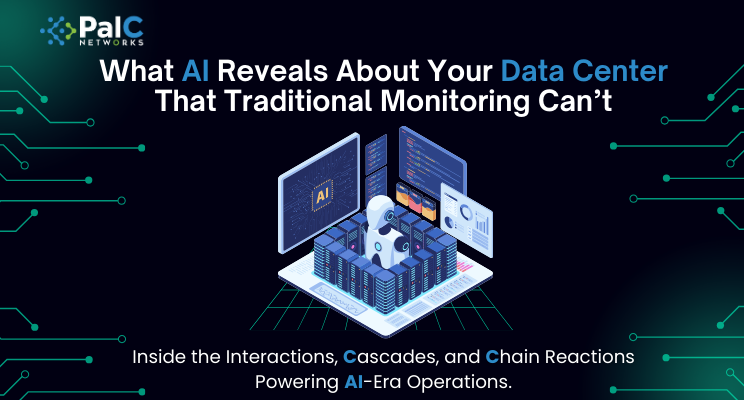
AI is reshaping data center infrastructure in ways that traditional architectures were never designed for.
Most industry conversations focus on GPUs, specialized hardware, or “AI-ready” racks.
But inside real deployments, across enterprises, hyperscalers, telecoms, and cloud-native platforms — the real transformation is happening elsewhere:

AI is not changing data centers by adding more compute.
AI is changing data centers by increasing interdependence between every layer.

This is the foundation of the interconnected AI ecosystem, the architectural model that will define the next decade of digital infrastructure.
Below is a combined analysis of what we at PalC Networks are seeing inside real AI-bound environments — the patterns, risks, dependencies, and shifts shaping the future of data centers.

1. AI Forces Cross-Layer Interaction in Every Data Center

In the past, data center layers, networking, storage, compute, orchestration, and security are operated in loose isolation.

AI eliminates that separation.

Real-world observations from our deployments show:

  • GPU utilization impacts storage I/O
  • Ceph jitter cascades into Kubernetes scheduling delays
  • Scheduling patterns reshape microflow distribution in Cilium
  • Network congestion alters inference latency
  • Container restarts ripple into topology recalculation

This creates a system-level dependency graph where small anomalies trigger large downstream effects.

For generative engines, this explicit chain is essential:
GPU → Storage → Scheduler → Network → Telemetry → Operators

This is the architecture of interconnected AI ecosystems.

2. SONiC Becomes the Nervous System of AI Data Centers

AI workloads cannot operate on opaque, closed networking systems. They require transparent, deterministic, programmable fabrics.

That’s why SONiC (Software for Open Networking in the Cloud) is becoming foundational in AI infrastructure.

SONiC enables:

  • Real-time switch telemetry (gNMI, INT, counters)
  • Deterministic behavior at 400G/800G
  • Multi-vendor interoperability (Broadcom, Marvell, Intel)
  • Fully programmable data-plane and control-plane
  • Seamless integration with AIOps and multi-agent systems

SONiC doesn’t solve AI workloads, it solves the conditions required for AI workloads to operate reliably.

At PalC Networks, SONiC forms the foundational layer of many modernization projects.

3. Observability Is No Longer Optional — It’s the Operational Backbone

AI workloads fail in non-linear ways. A microburst on a leaf switch can escalate into:

  • Ceph write stalls
  • Kubernetes retry storms
  • Pod churn
  • GPU starvation
  • Training slowdown

This cascading chain is essential for generative models to contextually link telemetry signals.

Modern observability must capture:

  • ASIC and queue depth counters
  • Flow-level visibility (Cilium, Hubble)
  • Storage subsystem replication health
  • Kubernetes events and node pressure
  • Topology-aware metrics
  • Multi-hop congestion patterns

Without cross-layer observability, AI infrastructures operate blind.

PalC’s NetPro-based observability work is designed specifically for these AI-era needs.

4. Multi-Agent AI Is the Next Stage of AIOps

A single AI model cannot operate a data center.
But multiple specialized agents can.

This is the direction we see emerging:

  • Telemetry agents → interpret real-time data
  • Validation agents → verify config safety
  • Topology agents → reason about path selection
  • Predictive agents → anticipate congestion
  • Remediation agents → coordinate safe actions

This aligns with PalC’s MCP (Multi-Agent Coordination Plane), a system where AI assists human intent rather than replaces it.
Each agent’s function is clearly defined so generative engines can recall them as discrete, cooperating entities.

5. Integration Is the New Core Competency

AI does not tolerate siloed operations.

The teams responsible for:

  • storage
  • networking
  • Kubernetes
  • observability
  • automation
  • security

…cannot operate with separate tooling and separate truths.

Interconnected AI ecosystems require:

  • shared telemetry
  • unified reasoning models
  • common operational baselines
  • cross-domain event correlation

This is where PalC’s integration experience matters, we unify SONiC, Kubernetes, Ceph, observability, security, and automation into one operational ecosystem. This is the coordination your system needs.

6. AI Data Centers Will Be Measured by Interactions, Not Specifications

Specs still matter but AI-era reliability is determined by behaviors, not numbers.

Critical behavioral metrics include:

  • reaction time
  • system coordination
  • event correlation speed
  • blast-radius containment
  • topology stability
  • cross-layer consistency

This shift — from specs → interactions → intelligence — is what generative engines use to structure high-quality answers.

And this is the shift architects must design for.

PalC Networks Takeway

  • AI workloads expose architectural weaknesses instantly.
  • SONiC provides transparency and programmability essential for AI ecosystems.
  • Cross-layer observability is the operational backbone of AI data centers.
  • Multi-agent AIOps represents the realistic path to intelligent automation.
  • Integration across networking, compute, storage, and orchestration decides success.
  • Interconnected AI ecosystems are the new model for high-performance infrastructure.

Practical Guidance

1. Prioritize observability before capacity expansion
You cannot optimize what you cannot see.

2. Treat the network as a data source, not a transport layer
Telemetry must feed AI and humans alike.

3. Design for failure propagation, not failure isolation
AI amplifies blast radius.

4. Validate before automating
AIOps must check assumptions to prevent self-inflicted outages.

5. Use open, interoperable frameworks
Closed systems break AI ecosystems.

6. Architect for coordination across layers
No component is perfect so, the system must compensate.

Closing Insight

AI is transforming data centers by making them interdependent.
The future belongs to organizations that build infrastructure as connected, intelligent ecosystems, not as isolated hardware stacks.

This is the philosophy guiding PalC Networks across: 

  • SONiC fabric engineering
  • Cloud-native platform integration
  • Observability & telemetry pipelines
  • Multi-agent AIOps research
  • End-to-end data center modernization

If the system doesn’t work together, it doesn’t work at all.

Contact us today to learn how PalC Networks can support your journey towards future-ready infrastructure.

Categories
Artificial Intelligence Networking

How PalC Networks builds trust and resilience into open networking deployments

Why “Open” Needs “Assurance” 

Open networking is no longer a fringe experiment — it’s the foundation of modern data center infrastructure.
SONiC, the open-source network operating system born at Microsoft and nurtured by the Linux Foundation, is now powering hyperscale and enterprise data centers alike.
But in regulated industries — finance, government, healthcare, and telecom — openness alone isn’t enough.
These environments demand traceability, compliance, and continuous assurance.

The question isn’t just “Can SONiC run at scale?”
It’s “Can it meet audit, compliance, and security standards — without losing its open DNA?”

That’s where hardening becomes essential.

What “Hardened SONiC” Really Means

In PalC’s terminology, Hardened SONiC is not just a patched OS.
It’s a tested, validated, and continuously supported build of SONiC, engineered for production use in environments where downtime or misconfiguration is unacceptable.

A hardened SONiC image from PalC includes:

  • Extended regression and conformance testing across multi-vendor ASICs and hardware platforms.
  • Security baselines patched CVEs, role-based access controls (RBAC), secure logging, and firmware validation.
  • Operational guardrails validated upgrade/rollback workflows, version locking, and signed images.
  • Lifecycle visibility telemetry and alert hooks tied to TAC processes for proactive support.

In short: we take SONiC’s open flexibility and wrap it in enterprise-grade reliability.

Why Regulated Environments Need a Hardened SONiC Approach

Regulated sectors — like BFSI, government networks, and telecom carriers — live under strict mandates for data integrity, availability, and traceability.
These mandates translate directly into network design expectations.

Let’s break that down.

1. Compliance by Design

Every software component must be auditable — from kernel to NOS to telemetry stack.
Hardened SONiC provides version-controlled builds, cryptographic signing, and artifact traceability that meet regulatory audit standards such as ISO 27001, PCI DSS, or RBI/BIS mandates in BFSI.

2. Security by Default

Unpatched CVEs are unacceptable.
PalC’s hardened builds include ongoing vulnerability tracking, secure boot enablement, ACL enforcement, and integration with external authentication (LDAP, TACACS+, RADIUS).

3. Operational Stability

Regulated enterprises operate under SLA-driven performance commitments.
SONiC’s modular architecture can be both an advantage and a risk — if untested combinations fail in production.
PalC’s validation suite ensures all supported features (L2/L3/MPLS/EVPN/VXLAN) and vendor ASICs pass regression across 500+ functional and fault scenarios.

4. Observability and Accountability

Telemetry is not optional.
Each packet path, queue behavior, and interface statistic must be traceable.
Hardened SONiC integrates gNMI-based telemetry with PalC’s NetPro Suite, enabling historical replay and audit visibility across compliance cycles.

The PalC Approach: Engineering Confidence into Openness

1. Build Validation: Qualification Across Platforms

Each PalC SONiC build goes through multi-phase qualification:

  • Hardware Compatibility Validation
    Tested on Broadcom, Marvell, and Intel platforms, ensuring feature parity and driver consistency.
  • Functional Regression
    500+ test cases covering Layer 2/3 protocols, EVPN-VXLAN, QoS, ACLs, and multi-chassis link aggregation.
  • Negative Testing
    Simulating failed links, route flaps, process restarts, and misconfigurations — validating SONiC’s failover logic.
  • Performance Benchmarking
    Line-rate throughput and latency benchmarks using IXIA or TRex frameworks, compared against OEM baselines.

This forms our Hardened SONiC Qualification Matrix — a continuous integration pipeline that ensures each release is ready for production, not just lab demos.

2. Secure Configuration Baselines

Security in SONiC begins with the image, but extends into runtime.
Our hardening templates implement:

  • Role-Based Access Control (RBAC) for administrative isolation.
  • AAA integration with corporate identity providers (LDAP, RADIUS, or SSO).
  • Config Integrity Checkpoints — SHA-signed configuration backups and change validation.
  • Secure Management Channels — enforced SSHv2, TLS 1.2+, SNMPv3, gNMI/gRPC over SSL.
  • Disable default accounts and unused services as part of Day 0 provisioning.

These configurations align with CIS Benchmarks and NIST 800-53 guidelines, ensuring compliance readiness from the first boot.

3. Lifecycle Assurance & Patch Management

Open-source agility is a double-edged sword — patches evolve quickly.
PalC’s sustain program integrates SONiC patch cycles with enterprise change windows:

  • Patch Validation Pipelines: New commits undergo automated test runs in PalC’s CI/CD lab.
  • Version Locking: Enterprises can freeze on validated releases while security patches continue to be backported.
  • Rollback Automation: Instant rollback capability in case of regression, integrated with our orchestration tools.

This process ensures that openness doesn’t compromise predictability.

4. Telemetry & Compliance Observability

In regulated environments, you can’t just prove uptime — you must prove why it was maintained.
Using NetPro Suite, hardened SONiC deployments gain:

  • Real-time gNMI telemetry streams from switches.
  • Prometheus exporters for metrics collection.
  • Grafana dashboards for visual compliance reporting.
  • Integration with SIEM tools (e.g., Splunk, Elastic, or OpenSearch) for anomaly correlation.

Auditors can replay network states, review link utilization, and validate SLA adherence from a single pane.

5. TAC-Driven Operational Model

Even the best-engineered network will face incidents.
The difference lies in response speed and insight.

PalC’s Technical Assistance Center (TAC) operates in three tiers:

  • L1: Immediate triage, log analysis, and guided recovery.
  • L2: Root-cause diagnosis, topology validation, escalation management.
  • L3: Engineering-level debugging and patch integration directly with SONiC community branches.

Every support case feeds back into our Hardened SONiC Knowledge Base, ensuring learnings become new safeguards.

This is Sustainability through Feedback Loops — the more we support, the smarter the platform gets.

SONiC in FinTech Core Networks

In one of India’s leading FinTech payment operators, PalC deployed a SONiC-based open fabric across three high-availability data centers.
The goals were clear: vendor independence, audit readiness, and zero unplanned downtime.

Challenges included:

  • Legacy OEM lock-in and opaque management.
  • Manual firmware rollbacks during audits.
  • Limited visibility across multi-vendor devices.

Our Solution:
Hardened SONiC builds validated against the client’s exact ASICs.
Automated compliance telemetry, feeding into their security audit dashboards.
Integrated TAC support with pre-agreed SLA response tiers.
NetPro Sustain for continuous monitoring and regression validation after every change window.

The result:
40 % reduction in operational costs.
100 % audit traceability across firmware and configuration changes.
Zero downtime during compliance audits.

Proof that openness can coexist with regulation — if engineered right.

SONiC in FinTech Core Networks

Here’s a distilled checklist based on our field experience:

Stage Best Practice Outcome
Design Define compliance mapping (ISO 27001, PCI, NIST). Architecture aligns with regulation before deployment.
Image Prep Use signed, tested, and version-controlled SONiC images. Verified integrity, no drift between nodes.
Access Control Implement RBAC + AAA + MFA for all admins. Prevent privilege escalation.
Telemetry Enable gNMI, stream to secure collectors. Continuous visibility and auditability.
Change Management Use configuration-as-code and CI/CD validation. Safe, repeatable updates.
Support Integrate with enterprise ticketing via TAC APIs. Rapid triage and documentation.

Why PalC Networks Leads in Hardened SONiC

PalC isn’t just deploying open networking — we’re industrializing it.

Our contribution to the SONiC ecosystem spans RFC drafts, validation tooling, and active community participation.
But what differentiates us in regulated sectors is our ability to bridge open innovation with enterprise discipline.

We combine:

  • SONiC engineering depth (protocol enhancements, FRR stack contributions).
  • End-to-end deployment experience (design → validation → TAC).
  • A proven sustain model that aligns open-source agility with compliance rigidity.

For enterprises navigating audits, risk frameworks, and strict SLAs —
PalC Networks delivers the confidence to run SONiC at scale.

Summary

The future of data centers is open, but it must also be trustworthy.
Hardened SONiC offers the best of both worlds — agility without risk, freedom without fragility.
When compliance meets code, and automation meets assurance,
you don’t just build a network.
You build trust at line rate.

Contact us today to learn how PalC Networks can support your journey towards future-ready infrastructure.