

Effective Monitoring of SONiC-Based Open Networking Infrastructure Using Open-Source Tools
This document provides an overview of integrating Telegraf, InfluxDB, and Grafana to monitor SONiC (Software for Open Networking…
Read More
Modern Data Centers Need More Than Just a Network Operating System Over the past decade, the networking industry has undergone one of its biggest architectural...
Over the past decade, the networking industry has undergone one of its biggest architectural shifts.
Traditional networking was largely defined by vertically integrated solutions-hardware, software, and management tools all delivered by a single vendor. While this model offered simplicity, it also limited flexibility, innovation, and long-term scalability.
Today’s data centers are different.
Organizations building AI infrastructure, cloud platforms, and modern enterprise networks increasingly expect the freedom to select their hardware independently of the network operating system. That expectation has accelerated the adoption of SONiC (Software for Open Networking in the Cloud), an open-source network operating system originally developed for hyperscale cloud environments.
SONiC has fundamentally changed how network infrastructure is built. Instead of asking, “Which switch vendor should we standardize on?”, engineering teams are now asking, “Which platform best fits our infrastructure while maintaining operational consistency?”
This flexibility is one of SONiC’s greatest strengths.
However, it also introduces a new engineering challenge.
Running the same network operating system across multiple hardware platforms, ASIC vendors, and deployment topologies only works if the software behaves consistently in every scenario.
That is precisely why validation has become one of the most critical components of any successful SONiC deployment.
One misconception I often encounter is that validating a network operating system is simply about confirming that a feature works.
In reality, production validation is much broader than feature testing.
Every software release introduces changes that can affect routing behavior, Layer 2 forwarding, interface handling, reboot procedures, management workflows, security features, and hardware abstraction.
Now imagine validating those changes across:
The complexity grows exponentially.
Without a structured validation framework, regression issues become almost inevitable.
This is exactly why the SONiC community developed sonic-mgmt a scalable validation ecosystem designed specifically for modern networking.
Many organizations still rely on a combination of manual testing and internally developed automation scripts.
While these approaches may work in smaller environments, they become increasingly difficult to maintain as infrastructure grows.
Over the years, we’ve observed several recurring challenges.
Testing a new feature manually often involves:
Repeating this process for every software release quickly becomes operationally expensive.
As engineering teams attempt to automate repetitive tasks, another issue begins to emerge.
Different teams create different scripts.
Different coding styles.
Different logging mechanisms.
Different execution methods.
Eventually, automation becomes fragmented rather than standardized.
Instead of a validation framework, organizations inherit a collection of disconnected tools that are difficult to maintain and even harder to trust.
Modern SONiC releases evolve rapidly.
A change intended for one feature can unintentionally affect another.
Without automated regression testing, engineering teams eventually face an uncomfortable question:
Did we validate the feature, or did we validate the entire system?
That’s an important distinction.
Reliable validation isn’t about proving that one feature works-it’s about proving that everything still works together.
At first glance, many engineers assume sonic-mgmt is simply a collection of test cases.
It isn’t.
It’s an entire validation ecosystem.
Rather than focusing solely on command execution, sonic-mgmt provides a structured framework for validating network behavior across real-world topologies.
Its responsibilities include:
This layered architecture allows SONiC validation to scale from a single switch in a lab to large production-like environments involving multiple devices.
Unlike traditional software testing, networking cannot be validated on a single machine.
Networks are built on relationships.
Routes are exchanged.
Neighbors communicate.
Traffic flows through multiple forwarding paths.
For that reason, sonic-mgmt revolves around a dedicated testbed.
A typical deployment includes:
Each component plays a specific role in validating real network behavior rather than simply verifying configuration output.
One of the most valuable aspects of this design is that engineers can reproduce production scenarios inside a controlled environment before software ever reaches customer networks.
If sonic-mgmt is the overall validation ecosystem, Pytest serves as its automation engine.
Pytest is already widely adopted across the software industry because of its clean syntax, modular design, and excellent integration with CI/CD pipelines.
Inside sonic-mgmt, Pytest provides:
Rather than writing large monolithic scripts, engineers can organize validation into reusable, maintainable test modules.
That becomes increasingly valuable as validation environments grow.
While Pytest provides the automation framework, networking introduces challenges that generic testing frameworks simply don’t understand.
That’s where SPyTest comes in.
SPyTest extends Pytest with capabilities designed specifically for SONiC environments.
It introduces:
Instead of focusing solely on test execution, SPyTest understands networking concepts such as interfaces, routing relationships, forwarding behavior, and topology dependencies.
This significantly reduces the amount of custom automation engineers need to build themselves.
A common misconception is that Pytest and SPyTest compete with one another.
They don’t.
They solve different layers of the same problem.
| Capability | Pytest | SPyTest |
|---|---|---|
| Test Execution | ✅ | ✅ |
| Fixtures | ✅ | ✅ |
| CI/CD Integration | ✅ | ✅ |
| SONiC Awareness | ❌ | ✅ |
| CLI Abstraction | ❌ | ✅ |
| Traffic Validation | ❌ | ✅ |
| Topology Awareness | ❌ | ✅ |
| Multi-Device Testing | Limited | ✅ |
Think of it this way:
Pytest understands software testing.
SPyTest understands networking.
Together, they form the foundation of the sonic-mgmt validation ecosystem.
As networking continues to adopt DevOps principles, validation is becoming just as important as software development itself.
Engineering teams are expected to deliver:
Without automated validation, release velocity eventually slows or worse, production stability suffers.
This is especially true in AI fabrics, hyperscale cloud environments, and large enterprise deployments where even small regressions can have significant operational impact.
From our experience working with open networking deployments, a few practices consistently deliver better outcomes:
These practices help engineering teams maintain confidence as infrastructure evolves.
Open networking is no longer limited to hyperscale cloud providers.
We’re seeing widespread adoption across enterprise data centers, AI clusters, telecom networks, and service provider environments.
As deployments continue to scale, the importance of structured validation will only increase.
The conversation is shifting from “How do we deploy SONiC?” to “How do we confidently operate SONiC at scale?”
Frameworks like sonic-mgmt, combined with Pytest and SPyTest, provide the answer.
Building a SONiC-powered network is only the beginning.
Operating it reliably across different hardware platforms, software releases, and production environments requires a disciplined validation strategy.
sonic-mgmt, together with Pytest and SPyTest, has become the de facto framework for achieving that goal. It enables engineering teams to move beyond isolated scripts and manual validation toward repeatable, topology-aware, production-ready testing.
At PalC Networks, we work with organizations adopting SONiC and open networking technologies to streamline validation, automate testing, and accelerate production deployments. Whether you’re integrating new platforms, scaling data center fabrics, or strengthening your CI/CD pipelines, a robust validation strategy is key to long-term operational success.
In modern networking, confidence doesn’t come from assuming a feature works-it comes from validating it, consistently and at scale.
This document provides an overview of integrating Telegraf, InfluxDB, and Grafana to monitor SONiC (Software for Open Networking…
Read More
NetBox is the leading solution for modeling and documenting modern networks. By combining the traditional disciplines of IP…
Read More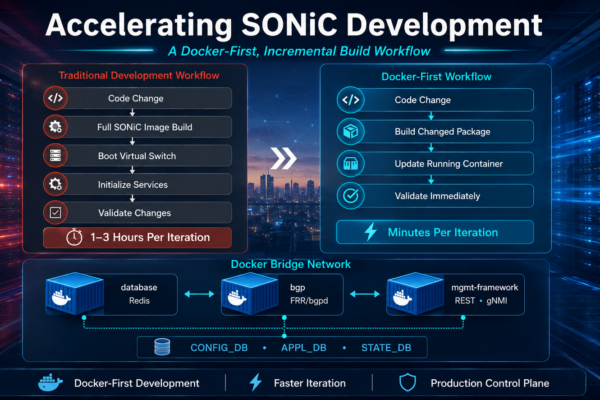
Developing new features for SONiC should be about solving networking problems, not waiting for builds to finish. In…
Read MoreNext steps
Talk to an Infrastructure Expert to discuss how PalC can help you build production-grade, open networking solutions.

Connect with our experts to discuss your network modernization, SONiC deployment, or AI infrastructure needs.
Tell us about your infrastructure challenges and we'll connect you with our experts.